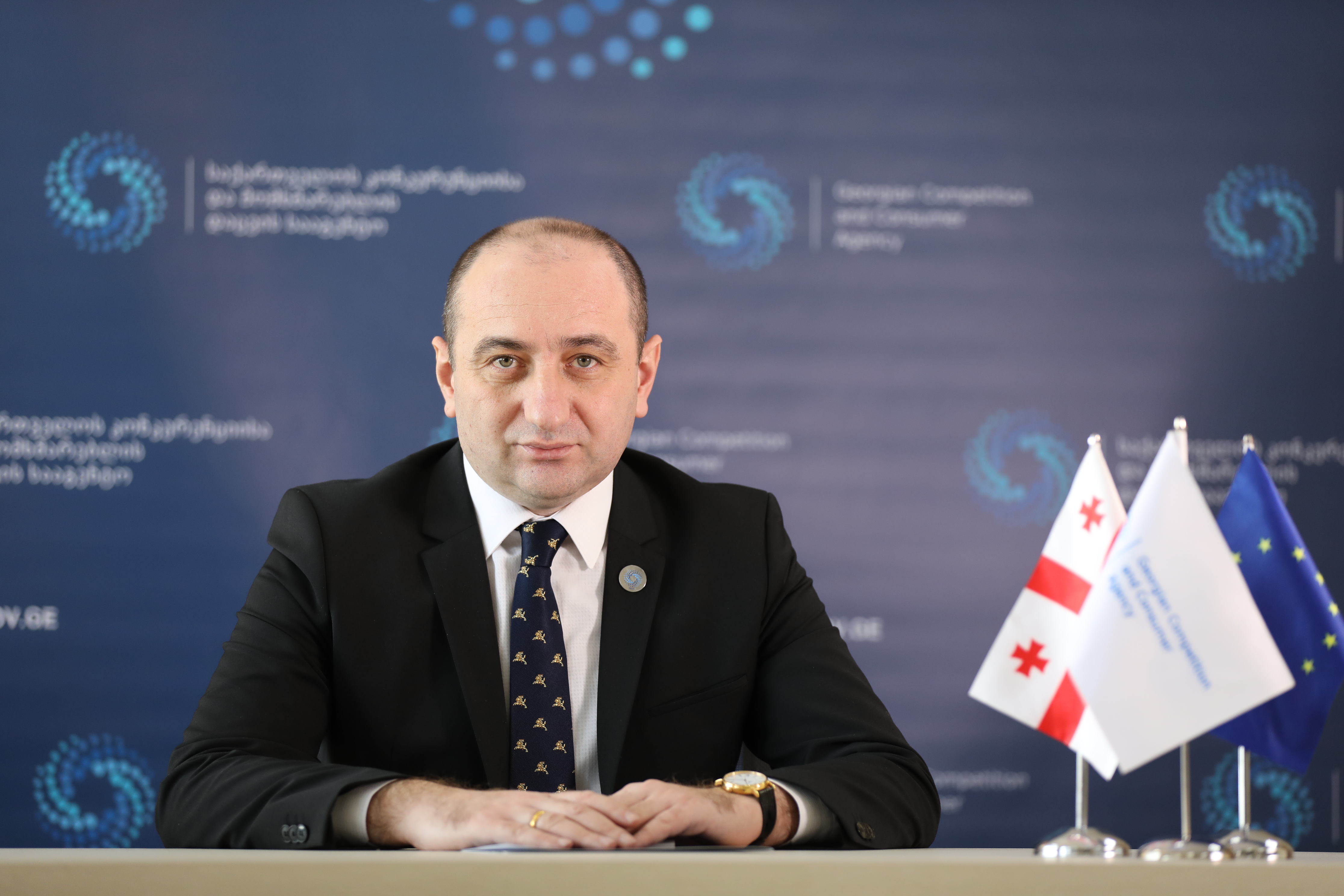
Irakli Lekvinadze
The year 2025 marked a successful milestone in the history of the Georgian Competition and Consumer Agency (GCCA). Twelve years after its establishment, the Agency has demonstrated substantial progress both in strengthening its impact on domestic markets and in enhancing its international recognition and engagement. Looking ahead, 2026 will mark the 30th anniversary of the establishment of Georgia’s first independent antimonopoly authority and the development of the country’s competition policy framework. This milestone will receive particular attention throughout the year, highlighting its significance in the broader context of Georgia’s economic development.
During the past year, the Georgian Competition and Consumer Agency (GCCA) continued to strengthen its international engagement, marked by several notable developments. First, the GCCA was elected, on behalf of Georgia, to the Presidency of the International Consumer Protection and Enforcement Network (ICPEN) for the 2026-2027 term. This development reflects the Agency’s growing role within the international consumer protection community. ICPEN brings together more than 90 jurisdictions and provides an important platform for cooperation, knowledge exchange, and the promotion of best practices in consumer protection. In this capacity, Georgia is scheduled to host a high-level international conference in September 2026, which is expected to further support international dialogue and reinforce the country’s global engagement in this field.
Another important recognition came from the World Bank, which acknowledged the GCCA’s work in the pharmaceutical sector. The Agency’s decisions and subsequent recommendations contributed to tangible improvements in the consumer environment and were recognized among the most impactful initiatives submitted by 40 countries. The award ceremony was held in Edinburgh. Additionally, assessments conducted in September by the World Bank and ICPEN highlighted the effectiveness of the GCCA’s communication strategy in the field of consumer protection. These evaluations noted that the Agency’s proactive outreach and communication efforts have contributed to strengthening consumer awareness and improving market transparency.
In the course of enforcing competition policy, the Agency concluded four investigations during the reporting period. In two cases, excessive pricing detrimental to consumers was established. In the remaining two cases, no infringements were identified, however, the Agency issued appropriate recommendations.
One significant investigation concerned the pharmaceutical sector, where four wholesale suppliers of medicines were found to have engaged in anti-competitive conduct resulting in excessive pricing. The investigation established that seven medicines had been sold with substantial markups prior to the introduction of reference pricing. Overall excessive pricing ranged between approximately 150% and 200%, while markups along the supply chain from customs clearance to retail distribution reached between 1,000% and 3,000%. The companies concerned were fined a total of approximately GEL 600,000. The investigation further indicated that pricing structures incorporated non-essential expenditures, including promotional gifts, conferences, hotel accommodation, luxury items, and operational costs associated with high-end vehicles. The subsequent introduction of reference pricing has significantly reduced the risk of similar practices recurring.
Another case concerned the Rustavi Auto Market, where parking fees imposed on vehicle importers more than doubled despite unchanged cost structures and no measurable improvement in service quality. The increase was assessed as excessive, and the responsible company was fined approximately GEL 900,000. The remaining two investigations concerned online platforms and the Batumi fish market, in both cases, the Agency did not establish violations.
The Agency undertakes continuous monitoring of a number of strategically significant sectors, including fuel, fast-moving consumer goods (FMCG), pesticides and agrochemicals, tobacco, blueberry and hazelnut exports, and medical services. On a periodic basis, the Agency publishes interim reports that provide a comprehensive assessment of competitive conditions in these markets, along with an in-depth analysis of key developments and emerging trends.
In 2026, the Agency will finalise comprehensive assessments of the pesticides and agrochemicals, as well as the medical services markets. Following the conclusions of these assessments, targeted recommendations will be submitted to the relevant policy-making authorities. The primary objectives of these monitoring activities are to identify instances of elevated mark-ups, evaluate market concentration levels, and analyse ongoing market dynamics, thereby supporting the effective protection of competition and the strengthening of the overall economic environment.
In 2025, the Agency approved 18 concentrations and reviewed approximately 24,000 registered business combinations. The highest number of concentrations was observed in the construction and construction materials sector, followed by the retail trade, medical, and education sectors.
The Agency maintains continuous oversight of concentrations implemented in Georgia, based on quarterly information obtained from the National Agency of Public Registry. Where undertakings fail to comply with the statutory notification requirements, the Agency imposes fines. In 2025, such breaches were identified in 9 of the 18 cases, and the Agency applied the relevant sanctions.
The Agency has continued the active enforcement of consumer protection legislation for the third consecutive year. In 2025, the number of consumer applications increased by 65%, indicating a sustained rise in consumer awareness and engagement with available protection mechanisms. Most complaints relate to online commerce, particularly in the clothing and electronics sectors, as well as transport and delivery services. On average, consumers recover approximately GEL 1 million annually through the Agency’s intervention.
Consumers who encounter defective, inadequate, incomplete, or damaged goods or services may submit complaints to the Agency free of charge, complaints are reviewed within one month. Depending on the findings, the Agency may: 1. Confirm a violation by the trader; 2. Determine that no violation has occurred; 3. Facilitate a commitment agreement between the trader and the consumer, under which the trader restores the consumer’s rights, aligns its commercial practices accordingly, and the proceedings are subsequently terminated. Most cases are resolved through such conditional commitment agreements; however, the number of confirmed violations has increased in recent years. In 2025, total fines exceeded GEL 100,000.
The GCCA continues to implement targeted awareness-raising initiatives aimed at enhancing consumer understanding of their rights and available protection mechanisms. Outreach activities are conducted both in Tbilisi and across the regions, including engagement with schools, higher education institutions, businesses, professional communities, persons with disabilities, and representatives of ethnic minority groups. Within this framework, the Agency has developed and introduced standards addressing service provision in the Georgian language, transparent presentation of prices and discounts, clear menu price disclosure, and other measures supporting effective consumer protection and informed decision-making.
In 2025, the Agency concluded one anti-dumping investigation concerning the possible dumping of reinforcing steel bar imports from Russia and Iran. Representatives of the domestic industry had raised concerns regarding pricing practices potentially affecting their financial sustainability. The investigation confirmed the existence of dumping price differentials. However, no recommendation for additional tariffs was issued, as safeguard tariffs introduced by the Government of Georgia in January 2024 on rebar and wire rod imports had already contributed to fair pricing conditions and provided an effective protective mechanism for the domestic industry.
In cooperation with sectoral regulatory commissions, the Agency hosted the IV International Conference on Competition and Consumer Protection in 2025. The conference brought together more than 50 international speakers from 18 countries and served as a key regional platform for reviewing recent developments in competition and consumer protection policy, while facilitating the exchange of international experience and best practices. Panel discussions addressed merger control, competition in digital markets, challenges in the healthcare and pharmaceutical sectors, consumer protection in online markets, and effective cooperation among regulatory authorities.
The Agency maintained strong international engagement throughout the year. In its capacity as Vice President, the GCCA chaired discussions on competition and consumer protection issues within the framework of the United Nations Conference on Trade and Development (UNCTAD) in Geneva. The Agency also chaired a dedicated panel at the OECD Global Forum on Competition and participated in a high-level session addressing emerging competition policy challenges in the healthcare sector.
While significant progress has been achieved, a number of strategic challenges remain that require sustained attention and coordinated action. These include further strengthening public awareness of competition and consumer protection principles, continuing to enhance the legislative framework, ensuring systematic assessments of strategic markets, and supporting the effective implementation of recommendations aimed at improving competitive market conditions.
Looking ahead, particular emphasis will be placed on advancing the integration of digital platforms and artificial intelligence initiatives, further developing modern consumer protection approaches and guidance, strengthening institutional capacity, and investing strategically in human capital to ensure long-term effectiveness.
In 2026, the Agency will continue to pursue proactive and forward-looking measures to promote fair competition and uphold high standards of consumer protection. The GCCA’s core objective remains unchanged: fostering a fair and transparent marketplace, ensuring effective consumer protection, and contributing to sustainable economic development oriented toward the interests and well-being of citizens.
In closing, I would like to express my sincere appreciation to all those who have contributed to the work and achievements of the Georgian Competition and Consumer Agency during the reporting period. I extend special thanks to the Agency’s dedicated team for their professionalism, expertise, and commitment. I would also like to acknowledge consumers and citizens for their trust, engagement, and active participation. We remain grateful to the Government and Parliament of Georgia for their constructive cooperation, as well as to state institutions and fellow regulatory authorities for their effective partnership and coordination. We also extend our appreciation to the business community, academia, and sector specialists for their constructive collaboration and engagement, and to the media for their valuable contribution to raising public awareness and fostering informed public discourse.